
Always Tired After Work? The Real Reason Ambitious Professionals Feel Drained
You’re performing well on the outside, but inside your energy is fading. If you’re constantly tired after work and don’t know why, this article breaks down what’s really happening, and how to fix it.
Braxira
8 min read

You are not lazy.
You are not unmotivated.
And you are not simply “bad at work-life balance.”
But something feels off.
You finish the day exhausted, even when nothing dramatic happened. Your calendar may look normal. Your performance may still look solid from the outside. You are meeting deadlines, replying to messages, and showing up the way people expect you to.
So why does it feel like your energy is quietly disappearing?
For a lot of ambitious professionals, this is where the problem begins. Not with a breakdown, but with a slow shift. Sleep stops feeling restorative. Focus takes more effort. Small things irritate you more than they used to. You are still functioning, but you are no longer operating from strength. You are operating from depletion. That pattern, subtle and easy to ignore, is exactly what makes silent burnout so dangerous.
Most people respond to this by trying to become more efficient. Better planning. Better routines. Better productivity systems. But when the real issue is energy loss, more optimization does not solve the problem. It just helps you push harder inside a system that is already draining you. Your E-book makes this point clearly, the old work-life balance playbook is broken, and traditional productivity advice often fails because it does not address the actual source of exhaustion.
If you are always tired after work, even when you are trying to do everything right, this article is for you.
Always tired after work? This is what’s actually happening
Feeling tired after a demanding day is normal. Feeling consistently drained, mentally foggy, and emotionally flat is not.
That difference matters.
A lot of high performers normalize exhaustion because the people around them are exhausted too. They assume this is just adulthood, modern work, ambition, leadership, or “a busy season.” But constant fatigue is often less about hours worked and more about the way your energy is being consumed throughout the day.
My E-book identifies the early signs clearly. Burnout does not usually arrive overnight. It shows up through physical red flags like poor sleep, persistent fatigue, headaches, tension, and increasing reliance on caffeine. It also appears emotionally, through irritability, dread, disconnection, and loss of enthusiasm, and cognitively, through forgetfulness, decision fatigue, and trouble focusing.
This is often how burnout starts, not with collapse, but with subtle, persistent energy loss.
And that is exactly why so many ambitious people miss it.
Why ambitious people are especially vulnerable
If you are driven, responsible, and capable, you can function at a high level for a surprisingly long time while running on very low reserves.
That is the trap.
Ambitious professionals are often praised for saying yes, staying available, moving fast, and carrying more than others. Those habits can look like strengths, and in the short term, they often are. But over time they create a dangerous pattern. You become highly effective at overriding your own signals.
You ignore the Sunday anxiety.
You dismiss the constant tiredness.
You explain away the irritability.
You keep going because you still can.
Until you cannot.
My E-book makes an important distinction here. The issue is not lack of ambition. The issue is trying to sustain an unsustainable pace. It argues for a new model, one built on sustainable integration instead of constant pressure, and strategic ambition instead of endless effort.
That is why this conversation matters. The goal is not to become less ambitious. The goal is to stop paying for ambition with your health, clarity, and relationships.
The hidden cost of being always on
One of the biggest reasons people feel exhausted after work today is that work no longer ends cleanly.
Even when your laptop is closed, your attention often is not. You think about tomorrow’s tasks at dinner. You check your messages without meaning to. You stay mentally available late into the evening. The result is not just long working hours, but fragmented recovery.
My E-book describes this clearly. Modern professionals are caught between unlimited ambition and finite energy. Remote work and constant connectivity have blurred boundaries, making it harder to disconnect and recover in a meaningful way.
This matters because recovery is not what happens when work stops on paper. Recovery is what happens when your mind, body, and nervous system actually get a chance to stand down.
When that does not happen, you can sleep and still wake up tired. You can rest and still feel unrestored. You can take a weekend off and still feel mentally crowded by Monday morning.
That is not a discipline problem. It is a depletion problem.
The real problem is not time management
This is where most advice gets it wrong.
When people feel overwhelmed or exhausted, they are told to manage their time better. Use a planner. Batch tasks. Wake up earlier. Build a perfect morning routine. But my E-book pushes against that entire mindset, and rightly so. The problem is not that ambitious professionals do not know how to work. The problem is that they are trying to work harder inside a model that no longer fits reality.
Time is fixed. Energy is not.
And yet most people try to solve an energy problem with a time solution.
That mismatch is why so many smart, capable people feel like they are failing despite doing everything “right.” They are not disorganized. They are depleted. They are managing calendars while ignoring capacity.
What they need is not more control over every minute. They need a system that protects, restores, and directs energy more intelligently.
You are managing time, but burning energy
This is the shift that changes everything.
My E-book introduces energy management as the real foundation of sustainable performance. It explains that energy is not one thing, but a combination of physical, mental, emotional, and meaningful engagement, and that managing these well matters more than squeezing more output from every hour.
Think about your day for a second.
Every meeting costs mental energy.
Every interruption costs focus.
Every difficult conversation costs emotional energy.
Every misaligned commitment costs motivational energy.
Every hour spent working against your natural rhythm increases the cost.
This is why you can technically have enough time and still feel completely empty.
You are not just spending hours. You are spending your internal resources.
And if those resources are not being renewed, protected, and used intentionally, exhaustion is inevitable.
The role of boundaries, and why they quietly disappear
Another reason ambitious people feel drained after work is that their boundaries slowly erode.
Usually this does not happen in one dramatic moment. It happens through small decisions that feel harmless at the time. You answer one message late. You take one extra meeting. You say yes to one more project. You help because you care. You stretch because you are competent. You stay available because you do not want to disappoint anyone.
But eventually, what was once an exception becomes your normal.
My E-book’s chapter on strategic no is especially strong here. It points out that overcommitment often comes from fear, fear of looking lazy, unhelpful, or less committed, and that people who set clear boundaries are often seen as more competent, not less.
That is a crucial reframe.
Boundaries are not a sign that you care less.
They are a sign that you understand your capacity.
And capacity is what protects quality, consistency, and long-term performance.
If you are always tired after work, one of the first questions worth asking is this:
Where am I leaking energy because I keep saying yes where I should be more selective?
Redefining success before it burns you out
There is another layer to this, and it is deeper than sleep, schedule, or workload.
A lot of ambitious people are chasing a version of success they never consciously chose.
My E-book explores this powerfully. It argues that many professionals inherit a definition of success from family, culture, workplaces, or social media, and then spend years organizing their lives around goals that do not actually support their wellbeing.
That matters because unclear success creates endless striving.
If success means always doing more, being more available, earning more, proving more, then of course rest feels guilty. Of course your boundaries feel selfish. Of course exhaustion feels like something to hide.
But if success includes energy, clarity, meaningful work, strong relationships, and sustainability, then the entire picture changes.
Now the question is not, “How much can I keep carrying?”
The question becomes, “What kind of life and career can I sustain with pride?”
That is a much better question. It is also a much more powerful one.
What actually helps when you feel drained after work
The answer is not to quit your ambition. It is to build a better operating system for it.
My E-book points toward a practical path:
First, recognize the warning signs earlier. Do not wait for a breakdown to take your fatigue seriously. Sleep disruption, irritability, reduced focus, and emotional flatness are signals, not inconveniences.
Second, start managing energy instead of just time. Notice when you are naturally sharp, when you crash, what drains you, and what restores you. My E-book recommends tracking personal energy patterns and matching tasks to energy levels rather than forcing the same output at all times.
Third, get better at strategic no. Protect your best energy for what matters most. My E-book frames this as selective availability, not withdrawal, and that is exactly right.
Fourth, build systems that support the version of you you are trying to become. Sustainable routines, weekly reviews, better transitions between work and life, and environments that reduce friction all matter more than random willpower.
What you need is not a hack.
You need a system.
If this feels familiar, this is not a quick-fix problem
If you recognized yourself in this article, the worst thing you can do is reduce it to “I should probably rest more.”
Because this usually is not about one bad week. It is about a pattern.
It is about being highly functional on the outside while your internal reserves are steadily dropping. It is about trying to solve a deeper issue with surface-level fixes. It is about carrying ambition in a way that slowly empties you out.
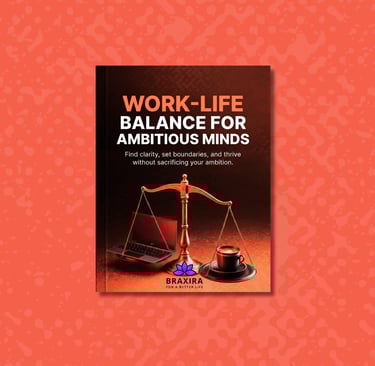
That is exactly why I created Work-Life Balance for Ambitious Minds.
My E-book is not about becoming less driven. It is about learning how to stay ambitious without burning yourself down in the process.
Inside, you will learn how to:
spot the early warning signs before burnout becomes a crisis
redefine success in a way that actually supports your wellbeing
set boundaries without guilt
manage your physical, mental, emotional, and meaningful energy more intentionally
build systems that make sustainable performance possible
If you are tired of feeling productive on paper but depleted in real life, this is your next step.
Download my E-book and start fixing the real problem
You do not need more pressure.
You do not need another productivity trick.
You do not need to wait until things get worse.
You need a better framework.
Download Work-Life Balance for Ambitious Minds and learn how to protect your energy, restore your focus, and build success you can actually sustain.
FAQ
Why am I always tired after work even when I sleep enough?
Because exhaustion is not only about sleep. It can also come from mental overload, emotional strain, constant context switching, poor boundaries, and lack of real recovery. My E-book describes this as a combination of physical, emotional, and cognitive warning signs that often build gradually over time.
Is being mentally drained from work a sign of burnout?
It can be. Burnout often starts with subtle symptoms like irritability, brain fog, reduced motivation, sleep disruption, and persistent fatigue, long before a person fully crashes.
What is the difference between time management and energy management?
Time management focuses on organizing hours. Energy management focuses on protecting and directing the internal resources that make performance possible, including focus, emotion, physical stamina, and motivation. My E-book explicitly argues that energy beats time for sustainable productivity.
Can ambitious people have work-life balance?
Yes, but not through old models of balance that assume perfect separation or endless capacity. My E-book reframes the goal as sustainable integration, where ambition and wellbeing support each other rather than compete.